The Glass Menagerie’s Broadway premiere
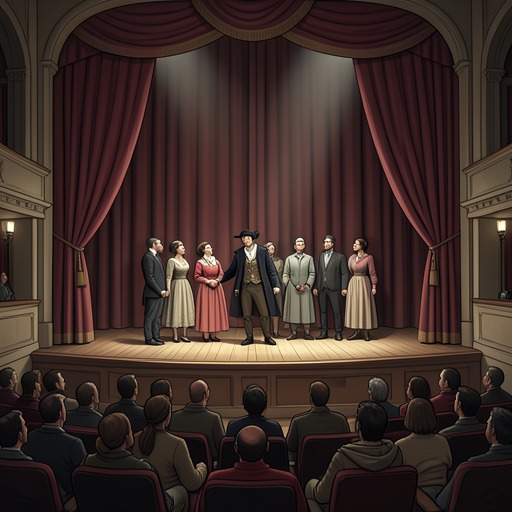
The Glass MenagerieThe Glass Menagerie’s Broadway premiere opened at the Playhouse Theatre in New York City on March 31, 1945, after the play’s first production in Chicago. Its arrival in New York marked the culmination of a difficult path to opening night and the beginning of a 563-performance run. The production made Tennessee Williams a sudden theatrical celebrity and helped announce a forceful alternative to the realistic conventions then dominant on the American stage.
From Chicago to Broadway
The play was first produced by Eddie Dowling and Louis J. Singer at the Civic Theatre in Chicago on December 26, 1944. Williams and his collaborators chose Chicago as the place to test the play before facing New York critics. Preparation was not effortless: producer Eddie Dowling and others urged substantial script changes, and the company worked through last-minute obstacles before opening. The play’s strong material, the cast’s performances, Williams’s persistence, and good fortune all contributed to its success.
After reviews came in, the production moved to the Playhouse Theatre in New York City, where it ran for 563 performances. The Broadway production was staged by Eddie Dowling and Margo Jones, with setting and lighting designed by Jo Mielziner and original music by Paul Bowles. The performance of Laurette Taylor as Amanda was especially celebrated; the production’s impact rested both on the pathos of the Wingfield household and on the force of Taylor’s portrayal.
A New Theatrical Language
The premiere presented a play shaped by Williams’s search for a more fluid dramatic form. Drawing in part on his long familiarity with movies, he sought a stage language that could organize action through composed visual images rather than rely on realistic dialogue and movement alone. His proposed “sculptural drama” emphasized restrained motion and carefully formed tableaux. The production’s final image—Amanda consoling Laura in a Madonna-like pose—embodied that ambition through stillness and visual composition.
Williams described the play as a memory play, for which unconventional techniques should bring theatrical experience closer to truth rather than evade reality. He argued that poetic transformation could represent life more deeply than photographic likeness. This aesthetic drew on techniques associated with European expressionism, but, joined to Williams’s romantic lyricism and emphasis on representing reality, it contributed to what the introduction identifies as a new force in American theatre.
The published script includes a screen device that was omitted from the Broadway acting version. Williams had conceived projected images or titles to emphasize the structurally important point of each episode and clarify allusions in an episodic narrative. He accepted the device’s omission, explaining that Taylor’s performance suited a production of utmost physical simplicity. The difference between the manuscript’s proposal and the stage production shows that the play’s formal ideas were adapted to the particular strengths of its original performance.
Sound, Light, and Memory
Music and lighting supplied meaning beyond the spoken text. A recurring tune, “The Glass Menagerie,” was designed to return between episodes as a thread connecting the narrator’s separate time and the story he recounts. Williams associated its light, circus-like quality with an underlying, persistent sorrow; because the tune was primarily Laura’s, it became clearest when the action focused on her and the fragile beauty represented by glass.
The lighting likewise rejected realism. The stage was to remain dim, with selective shafts of light establishing attention and contrast. In the quarrel between Tom and Amanda, Laura is not an active participant, yet the clearest pool of light falls on her; the supper scene similarly keeps her silent figure on the sofa as the visual center. Williams imagined a distinctive, pristine illumination recalling religious portraits and used such lighting to give a relatively static play a mobile, expressive quality. In one scene, the effect is joined to Laura’s nervous laugh, her retreat through the portieres, and the faint return of the recurring music.
The Broadway production’s closing stage picture concentrates these methods into an image of separation and feeling. While Tom speaks outside on the fire escape, the audience sees Amanda silently comforting Laura inside, as if through soundproof glass. Laura’s hair first hides her face; at the end of Amanda’s gestures, she lifts her head and smiles. Amanda then glances at the father’s photograph and withdraws, while Laura blows out the candles as Tom’s speech ends. The scene’s carefully arranged silence and movement make the family’s private grief visible even as the narration carries Tom away from it.
Reception and Consequence
The move to Broadway transformed Williams’s professional standing. The introductory account describes the response to the play as a remarkable change in American theatre: audiences were moved by the Wingfield family’s pathos, while critics and theatre enthusiasts were struck by Williams’s Southern manner, poetic language, and dramaturgical invention. Williams later recalled the change as being thrust from near-oblivion into sudden prominence, a success he regarded with bemusement as well as recognition.
The premiere’s significance extends beyond its immediate run. In a theatre climate characterized by realism and prosaic dialogue, the play’s memory-based form and expressive use of stage image, music, and light offered audiences a different kind of theatrical experience. Its account of domestic conflict also drew on the enduring dramatic power of family tensions: crises within an intimate household invite recognition and emotional response across cultural boundaries. The Broadway production thus established both Williams’s public breakthrough and the lasting stage vocabulary through which the play makes memory, fragility, and sorrow theatrical.